

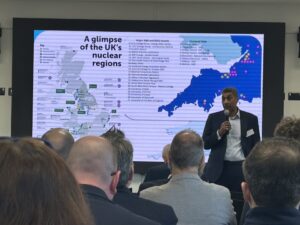
 The relaunch of Nuclear South West was described by attendees as a moment defined by “energy, passion and genuine collaborations”, with many noting that the event “set the tone” for a new phase of ambition. With 31,000 people working in the South West’s nuclear sector, the highest concentration anywhere in the UK, there was a strong sense of belief in the scale of opportunity ahead. Held on 28 January at the Firepool Digital Innovation Centre in Taunton, the event drew an impressive audience despite Somerset being in a state of flood emergency, and the morning opened with an hour of lively and purposeful networking.
Cllr David Woan opened the formal proceedings by reflecting on the significance of the venue itself. The Firepool Digital Innovation Centre, he said, represents Somerset Council’s commitment to innovation‑led growth, a place designed to bring together businesses, researchers and public‑sector partners to collaborate, innovate and scale. It is a space focused on skills, productivity and future technologies, making it an entirely fitting setting for a conversation about nuclear, energy security and long‑term economic resilience. He went on to describe the relaunch as an important moment for Nuclear South West, reminding the room that the cluster was created to bring coherence and momentum to a sector that is central to both the regional economy and the UK’s energy future. With the country entering a nuclear renaissance, from the progress at Hinkley Point C to the emergence of SMRs and AMRs, he stressed that this is not a moment for the South West to stand still. If the region wants to lead, he said, it must strengthen collaboration, prepare its supply chain, champion skills and make a compelling case for inward investment. 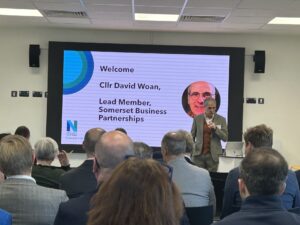
Somerset was positioned firmly at the heart of the UK’s new nuclear story. Hinkley Point C has already transformed the local economy, built deep technical capability and created a workforce now competing nationally. Looking ahead, Cllr Woan emphasised the importance of securing a long‑term legacy beyond construction by retaining skills, redeploying capability and ensuring local businesses are connected into future nuclear programmes across civil, defence and decommissioning. He closed by reaffirming Nuclear South West’s role as the connective tissue linking places, programmes and people so that more than a decade of investment delivers lasting regional benefit.
He then introduced the new Chair of Nuclear South West, Jay Bhart, who set out a clear and confident vision for the cluster’s future. Jay reiterated that Nuclear South West exists to bring coherence, visibility and momentum to a sector that is vital to both the region and the UK. With the UK entering a genuine nuclear renaissance, he warned that this is not the time for the South West to pause or lose focus. If the region wants to lead rather than follow, it must raise its ambition: deepen collaboration, strengthen supply‑chain readiness, champion the skills pipeline and present a compelling case for inward investment. While Somerset sits at the centre of the UK’s nuclear story, Jay reminded the audience that the wider South West also has significant capability that must be recognised and mobilised. He too focused on legacy, emphasising the need to retain and redeploy skills and connect businesses into future programmes across civil, defence and decommissioning. He closed by reaffirming Nuclear South West’s role as the connector that brings the region together to turn opportunity into delivery.
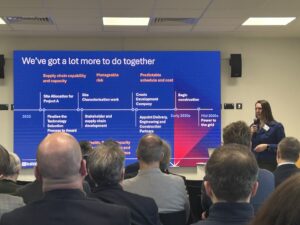 Helen Perthen of Great British Energy Nuclear (GBEN)followed with an overview of the UK’s untapped nuclear heritage and the organisation’s priority focus on identifying future sites for SMRs and AMRs. She explained that a full assessment is underway, including decisions around Oldbury, whether to retain it pending future government decisions or release it for another nuclear or associated project, and outlined the timelines and opportunities associated with SMR development at Wylfa. She emphasised that one of GBE N’s key priorities will be working with regional clusters to maximise visibility of these opportunities and identify where supply‑chain gaps can be filled locally.
The event then turned to public perception. Drew Aspinwall of SEC Newgate presented findings from their recent report on UK attitudes to nuclear, noting that political and public sentiment is shifting and that the sector must work proactively to build trust. Ruth Sellick of the UK Nuclear Regions Group highlighted the importance of engaging the next generation, while Alisdair Harper of DESNZ stressed the need for a trusted communicator for positive nuclear messaging, acknowledging that government alone cannot fulfil that role.
Dame Judith Petts then launched the Great South West prospectus, A New Nuclear Future, produced with support from Dorset and Somerset Councils. The document highlights the region’s unique strengths, licensed sites, community familiarity with nuclear operations, a skilled and mobile workforce and a resilient supply chain that has already supported billions of pounds of investment. It also sets out the scale of the national opportunity, from SMRs and AMRs to hydrogen, sustainable fuels and industrial heat, and positions the South West as a natural location for rapid deployment. The prospectus provides a platform for continued engagement with government, GBEN, developers and investors as decisions on new nuclear gather pace.
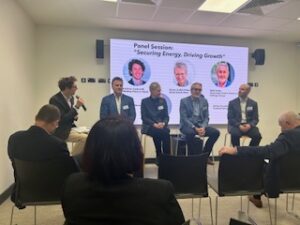 The first panel session, hosted by Andrew Cockcroft of EDF Energy, explored what it would take to secure energy and drive growth in the South West. Contributions ranged from the need to showcase existing strengths and link groups together, to the importance of NSW in shaping a major regional skills strategy. Panellists called for a unified regional voice to support Net Zero ambitions and highlighted the opportunity to join up wider energy sectors to position the South West as a green energy superpower. There was strong emphasis on the value of sharing lessons learned from Hinkley Point C to strengthen regional capability and open doors to future projects such as Sizewell.
The final panel session, chaired by Matthew Williams of SEC Newgate, focused on the future direction of Nuclear South West. Jay Bhart emphasised the need for aligned communication and priorities before moving forward, the establishment of a strong NSW Board with the right expertise and influence, and the creation of working groups to drive delivery. He issued a clear call to action for individuals to express interest in joining the Board. Corinne Matthews spoke about the importance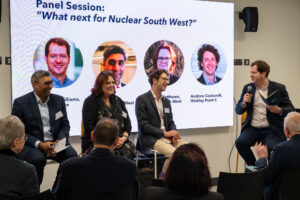 of getting legacy right, ensuring people are upskilled, opportunities maximised and capability transitioned into new regional projects. She highlighted how the region’s success at Hinkley Point C helped attract major investments such as Agratas, and how these achievements must now be promoted to secure further opportunities. Andrew Cockcroft reinforced the importance of capturing lessons learned, noting that with 5,000 people currently working on Hinkley Point C in Somerset, supported by thousands of supply‑chain businesses, the region has unparalleled capability in delivering major infrastructure. The risk, he warned, is losing that investment if action is not taken. NSW can help ensure skills, knowledge and opportunity flow into future projects.
The event closed with a final call to action from Jay Bhart, thanking speakers and delegates and encouraging everyone to get involved, help shape the Board and play an active role in building the next chapter for Nuclear South West.
All slides will be added as received.
GBE-N Supply Chain Communications
SEC Newgate – A Nuclear Divide